THRESHOLD will be closed on Friday, April 3rd. We will reopen for business on Monday, April 6th.  

Four Phases of School Emergency Management

Last updated: January 21, 2026
visitor management system for schools, visitor badge for schools, visitor stickers for schools

According to the United States Department of Education, an all-inclusive school emergency plan is built on the four phases of emergency management and provide direction to the entire school community:

  1. Prevention/Mitigation
  2. Preparedness
  3. Response
  4. Recovery

School emergency plans must document everything that is required to implement and maintain the plan. Plans should be put in writing, communicated to all staff, and practiced regularly through drills and exercises. School staff should be trained, at least annually, in plan procedures. School emergency plans must be reviewed and revised on an on-going basis.

The United States Department of Education recommends that all school emergency plans:

  • Be developed and strengthened based on the local needs and characteristics of the school district and its buildings.
  • Be developed and maintained in collaboration with community partners.
  • Provide for all hazards and reflect the four phases of emergency planning listed above.
  • Ensure the safety of the whole school community, including students, staff, and visitors with disabilities and special needs.
  • Reflect the principles of the National Incident Management System.
Prevention begins with knowing exactly who is in your school. See how with these visitor management solutions.

1. Prevention/Mitigation
The prevention/mitigation phase is designed to assess and address the safety, security, and integrity of school buildings, learning environments, and students and staff. Prevention involves the actions taken by schools and school districts to decrease the likelihood that an emergency will occur, such as making school security improvements. Mitigation involves the actions taken to eliminate or reduce risks, damages, injuries, or deaths that may occur during an emergency, such as a natural disaster.

Schools do not have control over all the hazards that may impact them or be able to prevent all emergencies. However, schools can take action to minimize the impact of emergencies and reduce the likelihood of such hazardous events.

Creating safe and healthy school environments is part of schools’ and school districts’ daily operations. Many schools have programs aimed at preventing students from engaging in harmful behaviors, including social problem-solving or life skills programs, anti-bullying programs, and school-wide discipline efforts. Many schools also have adopted threat assessment procedures in order to identify students who may pose a threat to themselves or others.

Mitigating emergencies is also important from a legal standpoint. If a school or district does not take all necessary actions in good faith to develop a safe and secure school, it may be vulnerable to charges of unlawful negligence. For example, if a school has no security policy in place to document visitors to the building and someone walks into the school and does harm, the school can be held liable.

2. Preparedness
The preparedness phase readies schools to respond in a rapid, coordinated, and effective manner to an emergency. School emergencies can potentially impact every member of a school community – students, staff, and parents. Being well-prepared requires an investment of time and resources.

Preparedness is the process of:

  • Developing a school emergency plan.
  • Deciding what actions will be taken in an emergency.
  • Determining who will respond in an emergency before the emergency actually occurs.

It involves coordination between local school districts, individual schools, local law enforcement, and the community at large.

School emergency plans should be reviewed and revised regularly. Schools and districts should also conduct drills and exercises to familiarize everyone with the plan. In emergency situations, people rely on instinct and training. If everyone is familiar with emergency plans and procedures, response is streamlined and more effective.

3. Response
Response is the process of implementing appropriate actions while the emergency situation is unfolding. In this phase, schools and districts mobilize resources and implement emergency procedures necessary to handle the emergency.

“Universal procedures” are actions taken in response to any emergency, threat, or hazard in a school. There are six universal procedures:

  1. Lockdown
  2. Shelter-in-place
  3. Reverse evacuation
  4. Severe weather shelter area
  5. Evacuation/Relocation
  6. Reunification

4. Recovery
The goal of recovery is to restore the safe school environment as quickly as possible. The plan for recovery needs to be developed during the preparedness phase, not after an emergency or crisis situation.

Recovery consists of four main components:

  1. Academic
  2. Physical/Structural
  3. Business/Fiscal
  4. Emotional

In recovery planning, all four components need to be addressed. The recovery process may be short-term or long-term depending on the circumstances of the event. Time and resources need to be allocated accordingly.

Academic recovery consists of deciding when the school should reopen and the plan for academics to continue if the school cannot be opened in a timely manner.

Documentation is crucial for both physical/structural and business/fiscal recovery. Response procedures require necessary documentation for insurance policies and state and federal laws.

Emotional recovery is the process of assisting people with physical, psychological, and/or emotional trauma associated with experiencing tragic events. Training may be provided to staff to assist with the emotional impact of an event. Returning to the “normal” school day facilitates the healing process for students and staff.

A tool that School Emergency Management Teams have at their disposal to increase building security is a visitor management system. A visitor management system helps facility vulernability by always knowing who is in your school. eVisitor Software is a stand-along visitor management systems that can affordably increase your security and help you always know who is in your school. eVisitor makes it easy for facilities to log, identify, track, and run reports on visitors. Watch this video to learn more, then request a free demo today!

Picture of Paul Kazlauskas

Paul Kazlauskas

Paul joined Threshold in 2001 after graduating from Bryant University. After a few years in the Sales Department, Paul transitioned to the Marketing Team in 2005. Over the years, Paul has worked on developing & launching new products, been the designer of customer communication emails, and launched numerous web sites for the Threshold product line. Since 2011, Paul Kazlauskas has been deeply involved in the security and visitor management industry, writing extensively about emerging technologies, market trends, and best practices that shape the field. In addition to his editorial experience, he actively represents his organization at major security trade shows and in-person events, where he connects with industry leaders, explores innovative solutions, and strengthens relationships with customers. His work reflects a hands-on understanding of both the business and technical sides of the industry, earned through years of direct engagement and thought leadership within the security community. A native of Connecticut, Paul enjoys outdoor activities like kayaking, golfing & hiking, as well as spending time with his son and coaching his soccer and baseball teams.
Picture of Paul Kazlauskas

Paul Kazlauskas

Paul joined Threshold in 2001 after graduating from Bryant University. After a few years in the Sales Department, Paul transitioned to the Marketing Team in 2005. Over the years, Paul has worked on developing & launching new products, been the designer of customer communication emails, and launched numerous web sites for the Threshold product line. Since 2011, Paul Kazlauskas has been deeply involved in the security and visitor management industry, writing extensively about emerging technologies, market trends, and best practices that shape the field. In addition to his editorial experience, he actively represents his organization at major security trade shows and in-person events, where he connects with industry leaders, explores innovative solutions, and strengthens relationships with customers. His work reflects a hands-on understanding of both the business and technical sides of the industry, earned through years of direct engagement and thought leadership within the security community. A native of Connecticut, Paul enjoys outdoor activities like kayaking, golfing & hiking, as well as spending time with his son and coaching his soccer and baseball teams.

Subscribe to THRESHOLD Updates

Sheryl Kantor

Financial Analyst

Sheryl joined Threshold in April 2025. She earned her Bachelor’s degree in Accounting from Central CT State University in 2001 and went on to build a career spanning more than 20 years in regulated private water utilities. While Threshold operates in a very different industry, Sheryl brings extensive financial expertise and a strong foundation in regulatory environments. In her role, she is responsible for all accounting functions at Threshold, including the preparation of monthly financial statements, corporate reporting, cost analysis and the development of annual budgets. She also oversees the finance department, ensuring accuracy, efficiency, and strategic financial management across the organization.

Sheryl enjoys spending quality time with her sons and her dog, Ozzy. She has a passion for cooking and baking, and loves attending country music concerts whenever she gets the chance. In her free time, she’s happiest outdoors – whether that’s hiking scenic trails or relaxing by a cozy fire.

Stacy Keefer

Production Manager

Stacy Keefer is a results-driven operations and production professional with over 25 years of experience improving workflows, managing production schedules, and supporting business growth. She is known for streamlining processes, coordinating with vendors, and delivering projects efficiently and on spec. Stacy brings a practical, hands-on approach to solving operational challenges and driving performance across teams.

When not working, she can be found fishing, hiking, or enjoying a round of disc golf.

Aris DiGiulio

Senior Product Manager

Aris DiGiulio joined Threshold as Senior Product Manager in 2024, bringing more than a decade of diverse experience in brand management, new product development, consulting and entrepreneurship. In this role, Aris leads the Product team in all innovation efforts while supervising management of the existing product portfolio. He also directs the support and development team for eVisitor, Threshold’s successful proprietary visitor management software used by organizations to streamline access management.

With prior experience at large global organizations including Diageo, Schick and Kobrand Corporation, Aris is focused on driving innovation while maintaining a high level of product quality and customer support that defines the Threshold organization. This has resulted in multiple new products and software enhancements that have delivered solutions and improved experiences for businesses, visitors, contractors and employees.

Aris earned his bachelor’s degree from Stony Brook University and an MBA from Fordham University’s Gabelli School of Business. He resides in Fairfield, Connecticut and enjoys spending time with his wife and two daughters.

Noel Turner

Director of Sales and Marketing

Noel Turner is a seasoned veteran in the visitor management marketplace. She is currently the Director of Sales and Marketing for Threshold Visitor Systems, an Avery Products Company. Her employment there spans twenty years, the last eight in her current position.

Her degree in communications and her industry experience have served her well in leadership roles with the ASIS and ISDA (Identification Security Dealers Association), leading national trade organizations in the security marketplace. She’s an industry expert in bringing together businesses, which collectively and efficiently solve the end user’s visitor security issues and problems with the appropriate level of sophistication, technology and cost.

In her free time, Noel loves to go camping and spend time with her dog.

Suzanne Corcoran

General Manager

Suzanne Corcoran joined Threshold in 2001 after a career in network radio sales and promotion. Starting in Sales, she quickly became part of a new Product Development team, using her marketing and project management skills to help create and launch the original Visitor Badge product line.

Over the years, she has added various management responsibilities from Production to Finance, leading to her current role as General Manager. Suzanne and the Threshold leadership team are dedicated to growth via new product development, enhanced web and digital marketing, high quality propriety products and superior service to customers and partners alike, all while fostering a collaborative and rewarding workplace culture.

10% off your first order of Parking Decals and Hang Tags

Parking Hang Tags and Decals

SIMPLE SOLUTIONS FOR PARKING IDENTIFICATION

A simple, reliable way to manage parking for staff,
residents, students, and visitors.

Use code PARK10 during checkout.

[searchwp_form id=2]

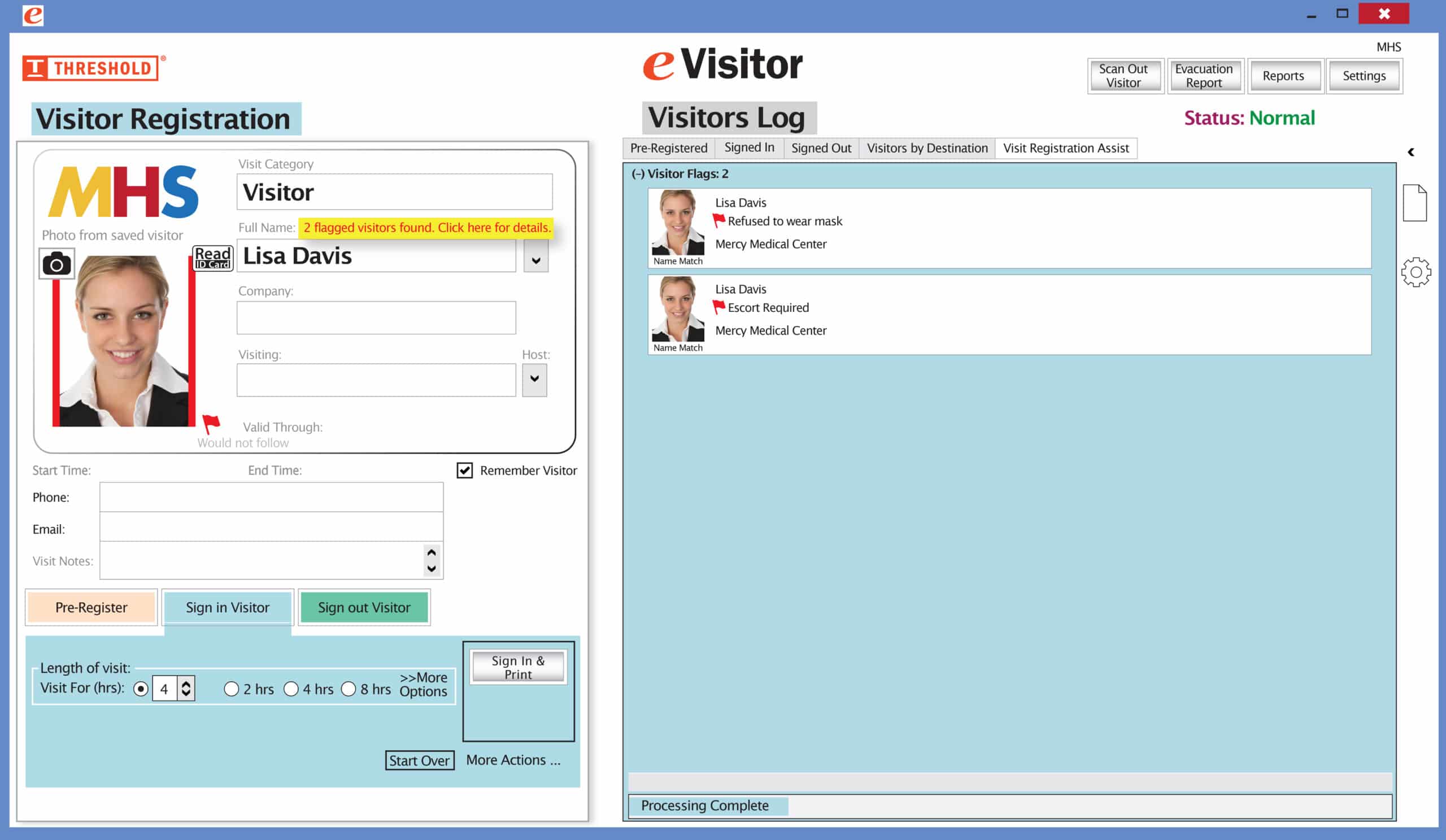
The Red Flag feature has been improved! Now you can set your system to not print a badge for any visitor record that has been previously marked with a Red Flag. The attendant will be prompted to redirect the visitor according to your security protocol.

Special New Feature: Red Flag, No Badge

Flag alertsIt’s easy and free to activate this feature. Simply call us and ask for “Red Flag, No Badge” to be turned on. Once it’s on, the above pop-up will come up when a red flagged visitor comes back. No badge will print and the attendant will need to follow the facility’s policy for handling red flagged visitors.

The flags and notes only show to the desk attendant, not the visitor. 

Please contact eVisitor Support with any questions on how to use Flags in your system. 

If you have seen a special offer in our advertising, mailings, or emails, this is the area to enter the Promo Code to receive that offer. After you’ve entered the Promo Code, click “Update cart” for the code to take effect. If you have any questions, please call 1-800-243-1969.